
If you hold Bitcoin, Ethereum, NFTs or any other cryptocurrency, your gains are taxed at a flat 30% under the Income Tax Act, 2025 — with no deductions except cost of acquisition, no set-off for losses and 1% TDS on every transaction above the threshold. This guide explains what qualifies as a VDA, how tax is calculated, how TDS applies and how to report VDA income.
What Is a Virtual Digital Asset (VDA)?
The term Virtual Digital Asset was introduced by the Finance Act 2022 and is retained under the Income Tax Act, 2025. A VDA includes: Cryptocurrency — Bitcoin (BTC), Ethereum (ETH), Ripple (XRP) and all other crypto coins and tokens Non-Fungible Tokens (NFTs) — digital art, gaming items and collectibles on blockchain Any other digital representation of value based on cryptographic technology Tokens created through initial coin offerings (ICOs) or token generation events
What Is NOT a VDA?
| Excluded | Why |
|---|---|
| Gift cards and vouchers | Not blockchain-based |
| Foreign currency (Forex) | Governed by Foreign Exchange rules |
| Mileage points and reward points | Not digital assets under the definition |
| Digital Rupee (CBDC issued by RBI) | Specifically excluded by the government |
How Are VDAs Taxed?
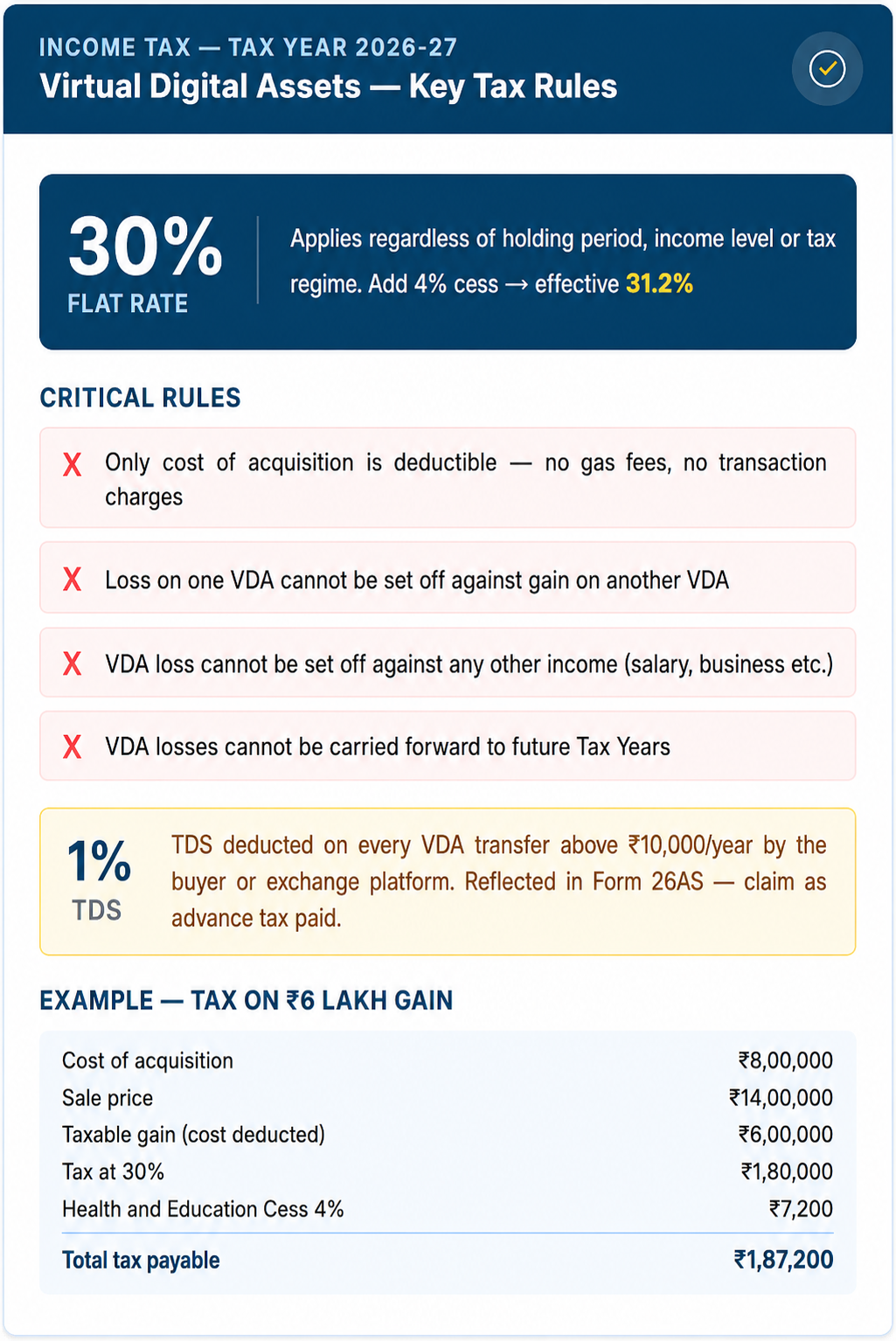
The taxation of VDAs is separate from all other income and applies at a flat rate regardless of your income level, tax slab or tax regime choice.
| Particulars | Rate |
|---|---|
| Tax on VDA income | 30% flat (no basic exemption benefit) |
| Surcharge | As per normal rates based on total income |
| Health and Education Cess | 4% |
| Effective rate (income below ₹50 lakh) | 31.2% |
No deduction is allowed while computing VDA income except the cost of acquisition (the original price paid to buy the VDA).
This means: Gas fees and transaction fees — not deductible No benefit of the basic exemption limit on VDA income No investment or insurance deductions (80C, 80D etc.) can be set off against VDA income
What Events Trigger VDA Tax?
| Event | Taxable? |
|---|---|
| Selling crypto for Indian Rupees (INR) | Yes — 30% on gain |
| Exchanging one crypto for another (e.g. BTC for ETH) | Yes — treated as sale of the first crypto at market value |
| Using crypto to pay for goods or services | Yes — treated as sale at fair market value |
| Selling an NFT | Yes — 30% on gain |
| Receiving crypto as salary or payment for services | Yes — taxable at market value on receipt date |
| Receiving crypto as gift (above ₹50,000 from a non-relative) | Yes — taxable at slab rate in year of receipt |
| Staking rewards received | Yes — taxable at market value on receipt |
| Airdrops received | Yes — taxable at market value on receipt |
| Crypto held in a wallet without any sale or transfer | No — no tax on unrealised gains |
| Transferring crypto between your own wallets | No — internal transfer is not a taxable event |
Loss on Sale of VDA — The Critical Restriction
Loss from a VDA cannot be set off against: Profits from another VDA — even if both are crypto (gains and losses across different tokens cannot be netted) Any other income — salary, business income, property income or capital gains from shares VDA loss also cannot be carried forward to any future Tax Year
Example Showing the Impact
| Transaction | Amount |
|---|---|
| Sold Bitcoin at a loss | ₹(2,00,000) |
| Sold Ethereum at a gain | ₹5,00,000 |
| You might expect to pay tax on ₹3,00,000 | ❌ Not permitted under IT Act, 2025 |
| Actual taxable gain — Ethereum only | ₹5,00,000 |
| Tax at 30% | ₹1,50,000 |
| Bitcoin loss — provides zero tax relief | Cannot be used or carried forward |
How to Calculate VDA Tax
Example 1 — Selling Bitcoin
| Particulars | Amount |
|---|---|
| Date of purchase | 10 January 2025 |
| Cost of acquisition | ₹8,00,000 |
| Date of sale | 15 July 2026 (Tax Year 2026-27) |
| Sale price | ₹14,00,000 |
| Gain (sale price minus cost of acquisition) | ₹6,00,000 |
| Tax at 30% | ₹1,80,000 |
| Health and Education Cess at 4% | ₹7,200 |
| Total tax payable | ₹1,87,200 |
There is no short-term/long-term distinction for VDAs — the rate is always 30% regardless of holding period.
Example 2 — Crypto to Crypto Exchange
| Particulars | Amount |
|---|---|
| Purchased 1 ETH for | ₹2,00,000 |
| Exchanged 1 ETH for BTC (ETH market value on exchange date) | ₹3,50,000 |
| Gain on ETH (treated as a sale at ₹3,50,000) | ₹1,50,000 |
| Tax at 30% | ₹45,000 |
When you exchange one crypto for another, the exchange is a taxable event — treated as a sale of the first crypto at its market value on the date of exchange.
TDS on VDA Transactions — 1% Deducted at Source
| Particulars | Details |
|---|---|
| TDS rate | 1% of the consideration (sale value) |
| Who deducts | The buyer — or the exchange platform when it facilitates the transaction |
| Threshold | ₹10,000 per Tax Year (₹50,000 for transfers between specified relatives) |
| When deducted | At the time of credit or payment — whichever is earlier |
Indian exchanges (WazirX, CoinDCX and others) deduct 1% TDS from your sale proceeds. This TDS appears in your Annual Information Statement (AIS) and Form 26AS.
| Particulars | Amount |
|---|---|
| You sell Bitcoin worth | ₹5,00,000 |
| TDS deducted by exchange at 1% | ₹5,000 |
| You receive in your account | ₹4,95,000 |
| Tax liability at 30% on gain | ₹1,50,000 |
| Less: TDS already deducted | ₹5,000 |
| Balance tax to pay | ₹1,45,000 |
TDS is an advance tax payment — it reduces the balance tax you owe. If TDS exceeds your total tax liability, you can claim a refund.
VDA Received as Gift
From a specified relative (parents, spouse, siblings): Exempt from tax on receipt From a non-relative exceeding ₹50,000 in a Tax Year: Taxable at slab rate in the year of receipt (not at the VDA flat rate of 30%)
When you later sell a gifted VDA, the cost of acquisition is the original cost to the person who gifted it — not the market value at the time of gift.
How to Report VDA in Your Tax Return for Tax Year 2026-27
VDA income is reported in a dedicated schedule of the income tax return under the IT Act, 2025. Cross-check all transactions against your Annual Information Statement (AIS) — the department pre-populates data from Indian exchange reports. Each transaction must be reported with date, cost and sale price. For foreign or decentralised exchanges (DEX), no TDS is deducted — compute and pay tax through advance tax or self-assessment tax before filing.
Practical Guidance for VDA Taxpayers
- Export all transaction history from every exchange — dates, amounts, fees and counterpart currency.
- Track each purchase separately — use FIFO when you have multiple lots at different prices to determine cost of each sale.
- Report all transactions — the AIS pre-fills exchange data and the department cross-checks returns.
- Pay advance tax — if VDA tax liability exceeds ₹10,000 for Tax Year 2026-27, pay in four instalments (June, September, December, March).
- Consult a Chartered Accountant — VDA taxation is complex for active traders, NFT creators and those receiving crypto as compensation.
The information provided herein is for general guidance and informational purposes only. For
advice tailored to your specific situation, please consult a qualified Chartered Accountant.