
Agricultural land is treated very differently under the Income Tax Act depending on where it is located. Rural agricultural land is not a capital asset — any profit from its sale is not taxable as capital gains. Urban agricultural land is a capital asset and gains from sale are fully taxable. This guide explains the classification rule, the agricultural income exemption, taxation on sale and all available exemptions including Section 54B and Section 10(37).
What Is Agricultural Land?
Agricultural land is land used for farming — cultivation of crops, horticulture, growing plants and allied activities such as animal husbandry and dairy farming when done on the same land. Income from farming activities on agricultural land is agricultural income and is exempt from income tax under the Income Tax Act, 2025.
However, the tax treatment of profit from the sale of agricultural land depends entirely on whether the land is classified as rural or urban .
Rural vs Urban Agricultural Land — The Classification Rule
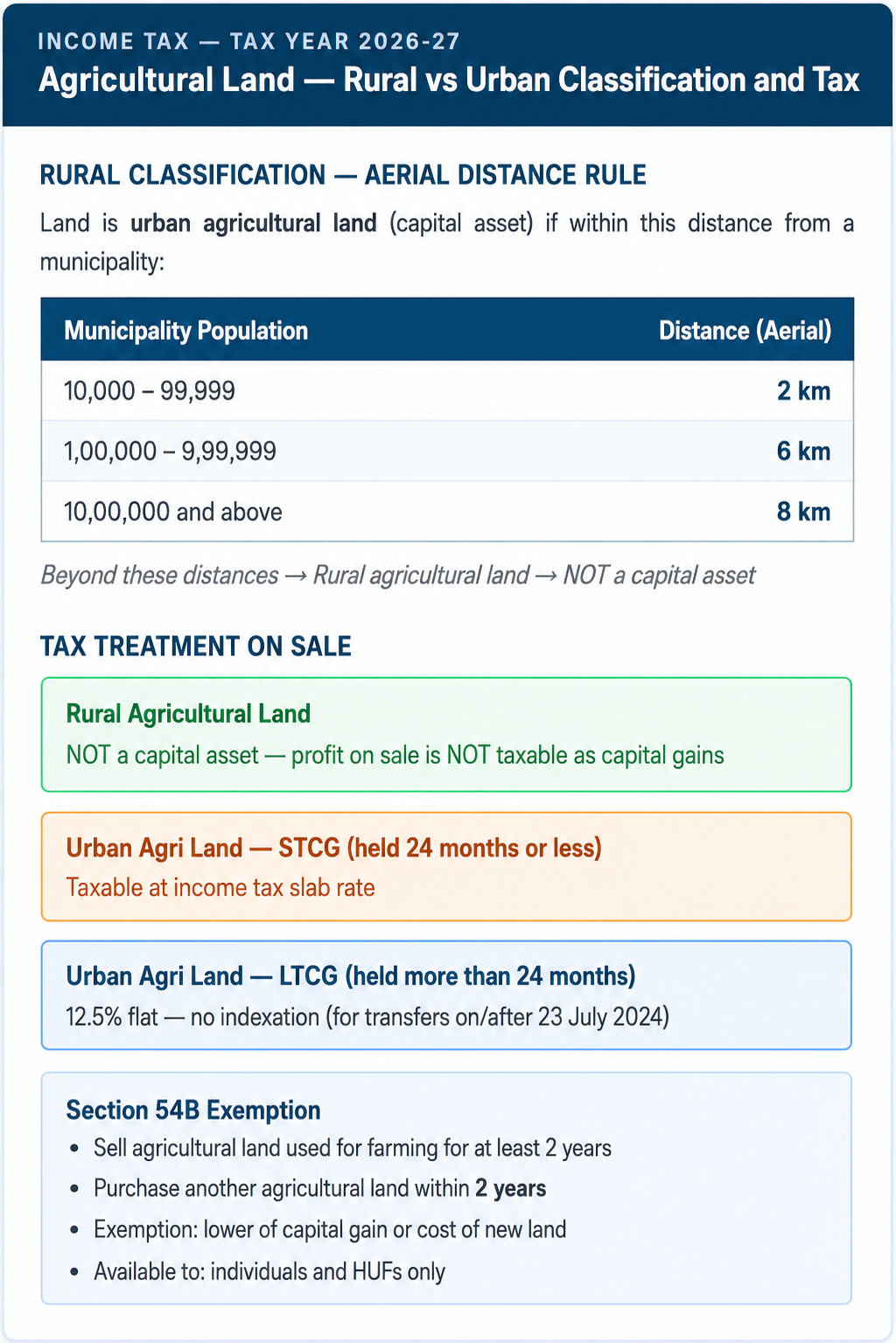
The Income Tax Act defines rural agricultural land as land satisfying both of the following conditions:
Condition 1 : The land must not be within the jurisdiction of a municipality or cantonment board having a population of 10,000 or more .
Condition 2 : The land must not be within the following aerial distances from the limits of any municipality or cantonment board:
| Population of Municipality or Cantonment Board | Land Within This Distance Is Urban Agricultural Land |
|---|---|
| 10,000 to 99,999 | 2 kilometres |
| 1,00,000 to 9,99,999 | 6 kilometres |
| 10,00,000 and above | 8 kilometres |
Land satisfying both conditions — outside the municipal jurisdiction and beyond the distance band — is rural agricultural land . Land that fails either condition is urban agricultural land .
Practical Application in Srikakulam
Srikakulam city has a population of approximately 2 lakh (between 1 lakh and 9.99 lakh). This means:
- Agricultural land within 6 kilometres of Srikakulam municipal limits → Urban agricultural land (capital asset — gains taxable)
- Agricultural land beyond 6 kilometres from Srikakulam municipal limits → Rural agricultural land (not a capital asset — not taxable)
The distance is measured aerially (straight line), not by road distance. A Tahsildar or Revenue Divisional Officer certificate confirming aerial distance is useful evidence if classification is ever disputed.
Agricultural Income — Exempt from Income Tax
Income from agricultural operations on agricultural land is fully exempt under the IT Act, 2025. Agricultural income includes:
| Type | Example |
|---|---|
| Rent from agricultural land | Leasing your farm to a tenant farmer |
| Income from cultivation of crops | Profit from paddy, groundnut, sugarcane, cotton |
| Income from orchards and plantations | Mango orchards, coconut groves, banana plantations |
| Farm building income | Rent from pump house, storage shed or farmhouse located on agricultural land |
What Is NOT Agricultural Income
| Income Type | Tax Treatment |
|---|---|
| Poultry farming | Taxable as business income |
| Fish farming (aquaculture) | Taxable as business income |
| Processing of agricultural produce beyond basic operations | Taxable as business income |
| Buying and selling agricultural land as a regular trade | Taxable as business income |
How Agricultural Income Affects Your Tax Rate — Partial Integration
Agricultural income is exempt, but it is included to calculate the effective tax rate on your other income. This rule applies when:
- Agricultural income exceeds ₹5,000 in the Tax Year, AND
- Total income (excluding agricultural income) exceeds the basic exemption limit
How the calculation works:
Step 1: Add agricultural income to your other income and compute tax on the combined total.
Step 2: Add agricultural income to the basic exemption limit and compute tax on that figure.
Step 3: Actual tax payable = Step 1 result minus Step 2 result.
| Particulars | Amount |
|---|---|
| Non-agricultural income (salary or business) | ₹6,00,000 |
| Agricultural income (crop sales) | ₹3,00,000 |
| Step 1: Tax on ₹9,00,000 combined | Computed at applicable slab rates |
| Step 2: Tax on ₹5,50,000 (₹3L agri + ₹2.5L basic exemption) | Computed at same slab rates |
| Actual tax = Step 1 − Step 2 | Net amount payable |
Agricultural income effectively pushes your other income into a higher slab without itself being taxed — relevant for farmers who also have salary or business income.
Sale of Rural Agricultural Land — NOT a Capital Asset, NOT Taxable
Rural agricultural land is not a capital asset under the IT Act, 2025. Therefore profit from its sale is not taxable as capital gains .
Important caveat : If a person habitually buys and sells agricultural land as a regular business, the profit may be treated as business income and taxed accordingly. This applies to active land dealers — not to farmers selling their ancestral or farm land.
Sale of Urban Agricultural Land — Capital Gains Tax Applies
Urban agricultural land is a capital asset. Capital gains tax applies on its sale.
Holding Period
| Period Held | Classification |
|---|---|
| 24 months or less from date of acquisition | Short-Term Capital Gain (STCG) |
| More than 24 months from date of acquisition | Long-Term Capital Gain (LTCG) |
Tax Rates for Tax Year 2026-27
| Type | Tax Rate |
|---|---|
| STCG on urban agricultural land | At your income tax slab rate |
| LTCG — land transferred on/after 23 July 2024 | 12.5% flat — no indexation benefit |
| LTCG — land transferred before 23 July 2024 | 20% with Cost Inflation Index or 12.5% without — whichever is lower |
Computation Example — Urban Agricultural Land LTCG
| Particulars | Amount |
|---|---|
| Sale price of urban agricultural land | ₹60,00,000 |
| Less: Purchase cost (acquired in 2018) | ₹15,00,000 |
| Less: Improvement cost (boundary wall, bore well) | ₹2,00,000 |
| Less: Transfer expenses at time of sale (stamp duty, registration) | ₹1,00,000 |
| Long-Term Capital Gain | ₹42,00,000 |
| Tax at 12.5% | ₹5,25,000 |
| Health and Education Cess at 4% | ₹21,000 |
| Total Tax | ₹5,46,000 |
Exemptions on Sale of Agricultural Land
Section 54B — Reinvest in Another Agricultural Land
| Condition | Details |
|---|---|
| Asset sold | Agricultural land (rural or urban) used by the taxpayer or their parents for farming for at least 2 years before sale |
| Reinvestment | Purchase another agricultural land anywhere in India |
| Time limit | Within 2 years from the date of transfer |
| Exemption amount | Lower of the capital gain or the cost of the new land |
| Eligible taxpayers | Individual and HUF only (not firms or companies) |
| CGAS option | If new land cannot be purchased before the return due date, deposit the capital gain amount in a Capital Gains Account Scheme (CGAS) account at an authorised bank before the due date and claim the exemption in the return |
Example applying Section 54B:
| Particulars | Amount |
|---|---|
| LTCG on sale of urban agricultural land | ₹42,00,000 |
| New agricultural land purchased within 2 years | ₹30,00,000 |
| Exemption (lower of LTCG or new land cost) | ₹30,00,000 |
| Taxable LTCG after exemption | ₹12,00,000 |
| Tax at 12.5% | ₹1,50,000 |
Compulsory Acquisition by Government — Section 10(37) Exemption
When the government compulsorily acquires agricultural land under any law (National Highways Act, Land Acquisition Act etc.), the entire compensation is fully exempt from income tax — provided: The land was used for agriculture by the individual or their parents for at least 2 years before acquisition The taxpayer is an individual or HUF
This exemption is particularly relevant in Andhra Pradesh where land acquisition for highways, ports and industrial corridors continues. Any enhanced compensation received from a court order is also fully exempt under this provision.
Documents Agricultural Landowners Should Maintain
- Pattadar Passbook and Title Deed — proof of ownership
- Pahani / Adangal records from Revenue Department — records crops grown each season; critical to prove 2-year agricultural use for the Section 54B exemption
- Registered sale deed and agreement for every purchase or sale
- Distance certificate from Tahsildar — confirms aerial distance from municipal limits if rural classification is disputed
- Auction receipts or MARKFED/procurement centre records — where you sell through a government procurement channel
- Bank records of all sale proceeds — traceability in case of income tax scrutiny
- Mutation records (Pahani entries) — confirm change of ownership in revenue records after each transaction
The information provided herein is for general guidance and informational purposes only. For advice tailored to your specific situation, please consult a qualified Chartered Accountant.