
A society is one of the most common structures for educational institutions,
cultural organisations, welfare associations and NGOs in India. This guide explains
what a society is, how many members are required, the registration process
under the Societies Registration Act, how educational societies obtain approvals,
the income tax exemptions available and ongoing compliance.
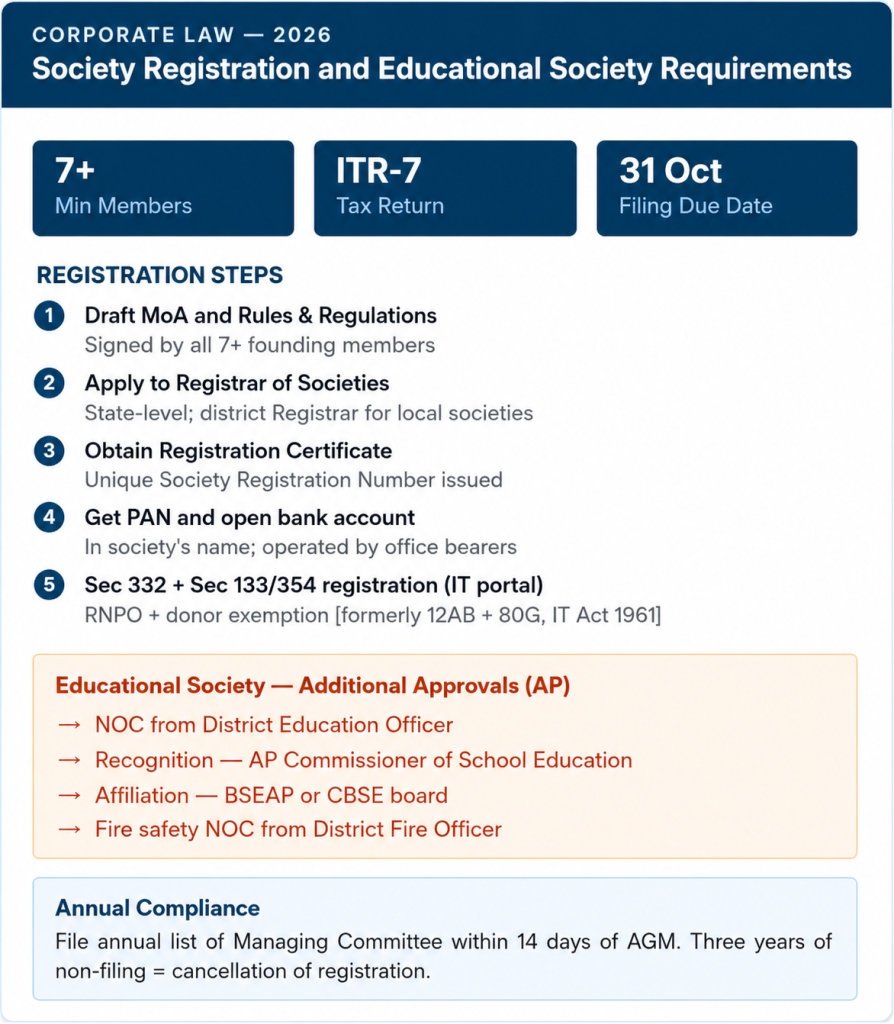
What Is a Society?
A society is a group of persons who come together for a common literary, scientific, charitable, educational, artistic, cultural, sporting or public welfare purpose and register themselves under the Societies Registration Act, 1860 (central law) or an equivalent state law.
Unlike a company (which focuses on profit) or a trust (where a settlor transfers property to trustees), a society is a member-based organisation governed democratically by its members through elected representatives.
In Andhra Pradesh , societies are registered under the Andhra Pradesh (Telangana Area) Public Societies Registration Act, 1350 Fasli as applicable, or under the Societies Registration Act, 1860 as adopted in AP.
Common Types of Societies
| Type | Purpose | Examples |
|---|---|---|
| Educational Society | Running schools, colleges, coaching centres or training institutes | AP Vignana Samithi, missionary school societies |
| Charitable Society | Providing relief, welfare or support to disadvantaged sections | Slum welfare societies, old-age home societies |
| Literary Society | Promoting literature, books, libraries and reading | District library societies, Telugu sahitya parishads |
| Scientific Society | Promoting science education, research or innovation | Science clubs, astronomy societies |
| Sporting / Athletic Society | Organising sports, games and athletic competitions | District cricket associations, kabaddi federations |
| Cultural Society | Promoting arts, music, dance, drama and local culture | Kuchipudi academy societies, folk art societies |
| Farmers or Agricultural Society | Collective welfare of farmers, cooperatives | Farmer producer organisations (FPO) as societies |
| Professional Society | Promoting a specific profession | Bar associations, medical associations |
Minimum Number of Members Required
| Requirement | Details |
|---|---|
| Minimum members to form a society | 7 persons under the Societies Registration Act, 1860 |
| Members must be | Individuals (companies, trusts and firms can also be members in some states) |
| Age | 18 years and above |
| Residency | No requirement to be AP residents, but at least some members should be present in the jurisdiction |
| Maximum members | No statutory maximum; as per the Rules & Regulations of the society |
For the Managing Committee (governing body), the deed typically specifies a minimum (usually 5 to 7) and a maximum number of committee members.
Governing Documents
Every registered society must have two foundational documents:
1. Memorandum of Association (MoA)
The MoA sets out: Name of the society Registered address (principal place of business in the state) Objects and purposes (must be lawful; not for profit distribution) Names, addresses and occupations of all founding members (signatories)
2. Rules and Regulations (Bye-Laws)
The Rules and Regulations govern internal working: Membership eligibility, admission and removal Categories of members (ordinary, life, patron etc.) and subscription fees Powers, duties and composition of the Managing Committee Procedure for meetings, quorum and resolutions Appointment, duties and removal of office bearers (President, Secretary, Treasurer) Audit and accounts procedures Amendment procedure Dissolution procedure and disposal of assets
Registration Procedure in Andhra Pradesh
Step 1 — Prepare Documents
- Memorandum of Association — signed by all founding members.
- Rules and Regulations — signed by all founding members.
- Address proof of the registered office.
- Affidavit by the President or Secretary declaring the correctness of documents.
- Identity proof of all founding members (Aadhaar / PAN / Voter ID).
- Certified true copies of all documents
Step 2 — Apply with the Registrar of Societies
The application is submitted to: Registrar of Societies (under the Commissioner of Labour, AP) for societies operating across the state District Registrar (Revenue Division) for societies operating within a single district
Step 3 — Certificate of Registration
The Registrar issues a Certificate of Registration with a unique Society Registration Number. The society is now a legal entity, separate from its members.
Step 4 — Obtain PAN and Open Bank Account
After registration, obtain a PAN in the society’s name and open a bank account operated by the office bearers as per the Rules.
Registration Fees in Andhra Pradesh
Registration fees are nominal (typically ₹500 to ₹2,500 depending on the jurisdiction and nature of society). Check with the local Registrar of Societies for current fee schedules.
Annual Compliance for Registered Societies
| Compliance | Details |
|---|---|
| Annual General Meeting | Must be held once a year; quorum as per Rules |
| Annual List of Managing Committee | Submitted to the Registrar within 14 days of every AGM (Section 4, Societies Registration Act) |
| Annual Statement of Accounts | Audited accounts filed with the Registrar |
| Change of address | Notify Registrar within 30 days |
| Change of Managing Committee | Submit updated list to Registrar |
| Amendment of MoA or Rules | Special resolution by members; file with Registrar |
Failure to file annual returns for three consecutive years can lead to cancellation of registration .
Educational Societies — Formation and Regulatory Approvals
An Educational Society is among the most common types of society in Andhra Pradesh. However, merely registering the society does not authorise it to run a school or college. Additional approvals are required:
To Run a School (Classes Nursery to XII)
| Approval | Authority |
|---|---|
| No Objection Certificate (NOC) | District Education Officer (DEO), Srikakulam |
| Land availability certificate | Village Panchayat or Municipal Corporation |
| Building safety certificate | Structural engineer or public works department |
| Recognition from State Government | AP School Education Regulatory and Monitoring Commission (SERMC) or Commissioner of School Education, AP |
| Affiliation (CBSE) | Central Board of Secondary Education (if CBSE board) |
| Affiliation (AP State Board) | Board of Secondary Education, AP (BSEAP) |
| Fire Safety NOC | District Fire Officer |
All AP private schools are governed by the Andhra Pradesh Schools (Regulation of Fees) Act, 2018 and must get fee approval from the prescribed authority.
To Run a Degree College
| Approval | Authority |
|---|---|
| NOC from AP State Government | Department of Higher Education, AP |
| Affiliation | The respective University (e.g. Andhra University, Rajiv Gandhi University of Knowledge Technologies) |
| NAAC Accreditation | National Assessment and Accreditation Council (for higher-grade recognition) |
| AICTE Approval (for technical courses) | All India Council for Technical Education |
| MCI/NMC Approval (for medical) | National Medical Commission |
Staff and Infrastructure Requirements for Schools in AP
Schools applying for recognition must demonstrate:
- Minimum land area as per the AP School Education norms (varies by type of school).
- Minimum classroom space per student.
- Adequate library, laboratory and playground facilities.
- Minimum number of trained teachers per class/section.
- Appointment of a Principal with prescribed qualifications
Income Tax Exemption for Societies
A registered society that carries out charitable or educational activities can obtain the same income tax exemptions as a charitable trust:
| Registration | Purpose | Form | Who Grants |
|---|---|---|---|
| Section 332, IT Act 2025 [Section 12AB, IT Act 1961] | RNPO registration — society’s own income exempt from tax | Form 10A | Commissioner of Income Tax (Exemptions) |
| Section 133/354, IT Act 2025 [Section 80G, IT Act 1961] | Donors can claim 50% deduction on their income tax | Form 10G | Commissioner of Income Tax (Exemptions) |
Application of Income Rules (Applicable to Educational Societies)
Under the IT Act, 2025, an educational institution registered as an RNPO under Section 332 [Section 12AB of the IT Act, 1961] must:
- Apply at least 85% of income to educational objects each Tax Year — as per Sections 335 and 336 [Section 11 of the IT Act, 1961]
- The remaining 15% may be accumulated
- Accumulated amounts must be applied within 5 years and kept in specified investment modes
Separate exemption route for educational institutions : The IT Act, 2025 consolidates the earlier Section 10(23C) of the IT Act, 1961 into the RNPO framework (Chapter XVII-B, Sections 332–355). Educational institutions with annual receipts below ₹5 crore that were previously covered under Section 10(23C)(iiiad) and 10(23C)(iiiae) of the IT Act, 1961 may now apply for RNPO status under Section 332 with simplified requirements. Institutions with receipts above ₹5 crore must apply for approval from the Prescribed Authority (CBDT-level) under Section 332(3).
ITR Filing
Educational societies must file ITR-7 on or before 31 October of each Tax Year (audit cases). They must also file:
- Form 10B (audit report) — for societies with income above ₹2.5 lakh
- Annual return to the Registrar of Societies — mandatory every year
Comparison — Trust vs Society vs Section 8 Company
| Particulars | Trust | Society | Section 8 Company |
|---|---|---|---|
| Governing Law | Indian Trusts Act, 1882 | Societies Registration Act, 1860 | Companies Act, 2013 |
| Minimum Members | 2 trustees | 7 members | 2 directors (private); 3 (public) |
| Registration | Sub-Registrar, state | Registrar of Societies, state | Registrar of Companies, central |
| Democratic governance | No (trustees decide) | Yes (managing committee elected by members) | Yes (board elected by members) |
| Dissolution | As per trust deed | By court order or 3/5 of members | By Registrar of Companies |
| Best for | Religious and family purposes | Membership-based associations, educational and cultural bodies | Large NGOs, CSR vehicles for corporates |
| Tax exemption route | Sec 332 + Sec 133/354 [formerly 12AB + 80G] | Sec 332 + Sec 133/354 [formerly 12AB + 80G] | Sec 332 + Sec 133/354 [formerly 12AB + 80G] |
Key Takeaways
- A society with 7 or more members can be registered with the Registrar of Societies for any charitable, educational, cultural or scientific purpose.
- Educational societies must obtain separate government recognition and university affiliation to run accredited schools or colleges — society registration alone is insufficient.
- For income tax exemption on the society’s income and to enable donors to claim deductions, apply for RNPO registration under Section 332 [formerly Section 12AB, IT Act 1961] and donor exemption approval under Section 133/354 [formerly Section 80G, IT Act 1961] on the Income Tax e-filing portal.
- File annual returns every year — three years of non-filing can result in cancellation.
- Maintain proper books of accounts, get them audited and file ITR-7 every year
The information provided herein is for general guidance and informational purposes only.
For advice tailored to your specific situation, please consult a qualified Chartered Accountant.