
A trust is one of the most widely used structures for charitable, religious and
family purposes in India. This guide explains what a trust is, the types of trusts,
who can create one, how many members are needed, the registration process,
approvals required for income tax exemption and donation deductions under
the Income Tax Act, 2025 and ongoing compliance.
What Is a Trust?
A trust is a legal arrangement in which one person (the author or settlor ) transfers ownership of property to another person or group of persons (the trustee/s ) to hold and manage it for the benefit of specified persons (the beneficiaries ) or for a stated purpose.
The relationship is governed by the Indian Trusts Act, 1882 for private trusts. There is no single central statute for public charitable trusts — they are governed by state-level laws, registration under the Registration Act, 1908 and, for income tax purposes, the Income Tax Act, 2025 .
In Andhra Pradesh, public charitable and religious trusts are also subject to the Andhra Pradesh Charitable and Hindu Religious Institutions and Endowments Act, 1987 .
Essential Elements of a Trust
Every valid trust must have:
- Author/Settlor — the person who creates the trust and transfers property to it.
- Trustee/s — person/s who hold and manage the trust property; legal title vests in the trustees.
- Beneficiaries — persons for whose benefit the trust exists (for charitable trusts, the public at large).
- Trust Property — the property transferred to the trust (money, land, building, movable property).
- Object of the Trust — the purpose for which the trust is created; must be lawful 6 Trust Deed — the document declaring and governing the trust.
Types of Trusts
| Type | Description | Examples |
|---|---|---|
| Public Trust | Created for the benefit of the general public; charitable or religious | Schools, hospitals, relief funds, religious temples |
| Private Trust | Created for the benefit of identified individuals (family members) | Family trust, will trust for children |
| Public-cum-Private Trust | Partially for public, partially for specific individuals | Mixed trusts with some family and some public beneficiaries |
| Discretionary Trust | Trustee has discretion to decide beneficiaries’ share | Family wealth trusts |
| Specific Trust | Beneficiaries’ shares are defined in the deed | Fixed inheritance trusts |
| Religious Trust | Created for religious purposes — maintaining temples, mosques, churches | Devasthanam trusts, dargah trusts |
| Testamentary Trust | Created through a Will; comes into effect after the author’s death | Estate planning through a Will |
| Inter-Vivos Trust | Created during the author’s lifetime; operative immediately | Charitable foundations, family trusts |
Who Can Form a Trust?
Any person competent to contract under the Indian Contract Act, 1872 can form a trust:
- Any individual who is 18 years of age or older and of sound mind
- A Company or LLP (as author of a public trust)
- HUF can be an author of a trust
- A foreign citizen (subject to FCRA compliance if foreign funds are involved)
- Government (government-endowed trusts)
Minors and persons of unsound mind cannot create a trust without a guardian’s involvement.
Minimum Number of Trustees
| Type of Trust | Minimum Trustees |
|---|---|
| Public Charitable Trust | 2 trustees (recommended minimum; many states require at least 2) |
| Private Trust | 1 trustee is legally sufficient under the Indian Trusts Act, but 2 is recommended |
| Public Religious Trust (AP) | As specified by AP Endowments Act — typically 2 or more |
There is no statutory maximum for the number of trustees, but the trust deed should specify the minimum, maximum and quorum for meetings.
The Author/Settlor can also be a trustee in a public charitable trust (though they typically should not be the sole trustee, as it may affect the independence required for exemptions).
Creation and Registration of a Trust
Step 1 — Draft the Trust Deed
The Trust Deed is the foundational document. It must contain: Name of the trust Name, address and details of the author/settlor Name, address and details of all trustees Objects and purposes of the trust Details of trust property transferred (initial corpus) Powers and duties of trustees Rules for managing the trust (meetings, quorum, decisions) Rules for inducting new trustees or removal of trustees Whether the trust is revocable or irrevocable
Step 2 — Execute and Register the Trust Deed
The Trust Deed must be executed on non-judicial stamp paper of appropriate value (varies by state and property value transferred) In Andhra Pradesh, the Trust Deed must be compulsorily registered with the Sub-Registrar of Assurances (Registration Act, 1908) if immovable property is being transferred to the trust Even where immovable property is not immediately transferred, registration is strongly recommended to give the trust legal standing Registration fee: As per AP Registration and Stamp Act (stamp duty on corpus value; varies)
Step 3 — Obtain PAN for the Trust
The trust must obtain a PAN (Permanent Account Number) from the Income Tax Department after registration. Apply online at the NSDL/Protean e-Gov portal.
Step 4 — Open a Bank Account
A bank account in the trust’s name, operated by the trustees as per the deed, is essential. Most banks require the registered Trust Deed, PAN and trustee identity documents.
Income Tax Registrations for Trusts — IT Act 2025
To receive income tax benefits, a public charitable or religious trust must obtain two separate registrations under the Income Tax Act, 2025:
A. Registration under Section 332 — Tax Exemption for the Trust’s Own Income
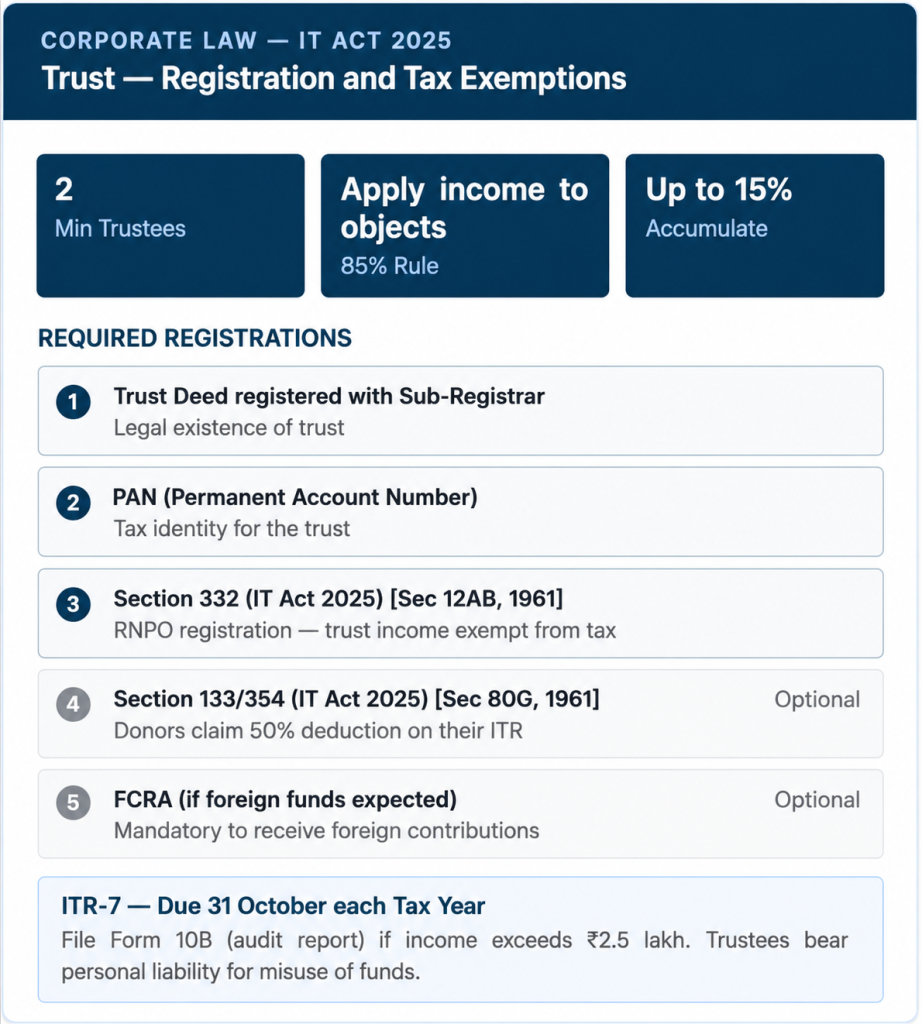
Under Section 332 of the IT Act, 2025 (replacing Sections 12A / 12AA / 12AB of the IT Act, 1961), all eligible charitable and religious organisations are now collectively called Registered Non-Profit Organisations (RNPOs) . The entire RNPO framework is contained in Chapter XVII-B (Sections 332–355) of the IT Act, 2025: Purpose : Exempts the trust’s own income (donations, rents, interest, fees) from income tax — provided the income is applied towards the charitable or religious objects Application : File Form 10A on the Income Tax e-filing portal online Grant : Commissioner of Income Tax (Exemptions) grants provisional registration initially for 3 years, then regular registration for 5 years at a time 85% application rule — Sections 335 and 336 [Section 11, IT Act 1961] : At least 85% of income must be applied to the charitable objects in the same Tax Year. The remaining 15% can be accumulated
Without Section 332 (RNPO) registration [formerly Section 12AB of the IT Act, 1961], the trust’s income is taxable at the normal rate applicable to Association of Persons (AOP) — which can be very high.
B. Approval under Section 133 and Section 354 — Enabling Donors to Claim Deduction
Under Section 133 of the IT Act, 2025 (replacing Section 80G of the IT Act, 1961) — read with Section 354 (replacing the Section 80G registration mechanism): Purpose : Allows donors who contribute to the trust to claim a deduction on their own income tax — 50% of the donation, subject to a ceiling of 10% of the donor’s adjusted gross total income Application : File Form 10G on the Income Tax portal after obtaining Section 332 (RNPO) registration Grant : Commissioner of Income Tax (Exemptions); valid for 5 years (renewable) Benefit to trust : Makes the trust more attractive to donors, as their donations become partially tax-deductible
Summary of Registrations Required
| Registration | Purpose | Form | Validity |
|---|---|---|---|
| Trust Deed with Sub-Registrar | Legal existence of the trust | Trust Deed on stamp paper | Permanent |
| PAN | Tax identification | Form 49A | Permanent |
| Section 332, IT Act 2025 [Section 12AB, IT Act 1961] | RNPO registration — trust income exempt from tax | Form 10A | 5 years (renewable) |
| Section 133/354, IT Act 2025 [Section 80G, IT Act 1961] | Donors can claim 50% deduction | Form 10G | 5 years (renewable) |
| GST (if applicable) | If services provided above threshold | GST portal | Annual renewal |
| FCRA | If receiving foreign contributions | Ministry of Home Affairs portal | 5 years (renewable) |
Taxability of Trust Income Under IT Act, 2025
If the Trust is Registered under Section 332 (RNPO) [Section 12AB, IT Act 1961]
| Income Type | Tax Treatment |
|---|---|
| Donations received and applied to objects | Exempt |
| Up to 15% accumulated | Exempt (accumulated amount must be applied within 5 years) |
| Income applied beyond objects | Taxable |
| Anonymous donations exceeding ₹1 lakh or 5% of total donations — Section 337, IT Act 2025 [Section 115BBC, IT Act 1961] | Taxable at 30% |
| Business income (if incidental to objects and within limits) | Exempt if applied to objects |
| Income from corpus donations | Exempt if invested as per specified modes |
If the Trust is NOT Registered under Section 332 [Section 12AB, IT Act 1961]
The trust’s income is taxed as follows: If income is below the basic exemption limit for AOP: Nil Above the basic exemption: Taxed at applicable AOP slab rates Interest on corpus is taxable as “income from other sources”
Key Compliance Requirements Under IT Act, 2025
| Requirement | Details |
|---|---|
| 85% application rule — Sections 335 & 336 [Section 11, IT Act 1961] | At least 85% of income must be applied to charitable objects each Tax Year |
| Accumulation — Section 336 [Section 11(2), IT Act 1961] | Up to 15% can be accumulated; excess accumulation taxed at 30% |
| Audit | Mandatory for trusts with income exceeding ₹2,50,000 before exemption |
| Form 10B / 10BB | Audit report — must be filed along with the return |
| ITR Form | ITR-7 (for RNPOs registered under Section 332 [Section 12AB, IT Act 1961]) |
| Due date | 31 October each Tax Year (audit cases) |
| Specified modes of investment | Trust funds must be kept only in specified modes (bank FDs, government securities, PSU shares etc.) |
Consequences of Non-Compliance
- Failure to apply 85% of income: Excess accumulation taxed at 30% plus surcharge and cess Failure to renew Section 332 (RNPO) registration [formerly 12AB, IT Act 1961]: Trust income becomes fully taxable
- Violation of investment norms: Entire income can be deemed taxable
- Failure to file audit report: Penalty under the IT Act
- Misuse of funds by trustees: Personal liability of trustees; criminal prosecution possible
Difference Between a Trust, Society and Section 8 Company
| Particulars | Trust | Society | Section 8 Company |
|---|---|---|---|
| Governing Law | Indian Trusts Act, 1882 | Societies Registration Act, 1860 | Companies Act, 2013 |
| Minimum Members | 2 trustees | 7 members | 2 directors |
| Registration | Sub-Registrar (state) | Registrar of Societies (state) | Registrar of Companies (central) |
| Control | Trustees hold full control | Governed by elected managing committee | Board of Directors |
| Suitable For | Religious and family trusts | Literary, scientific, educational associations | CSR activities of companies; large NGOs |
The information provided herein is for general guidance and informational purposes only. For advice
tailored to your specific situation, please consult a qualified Chartered Accountant.