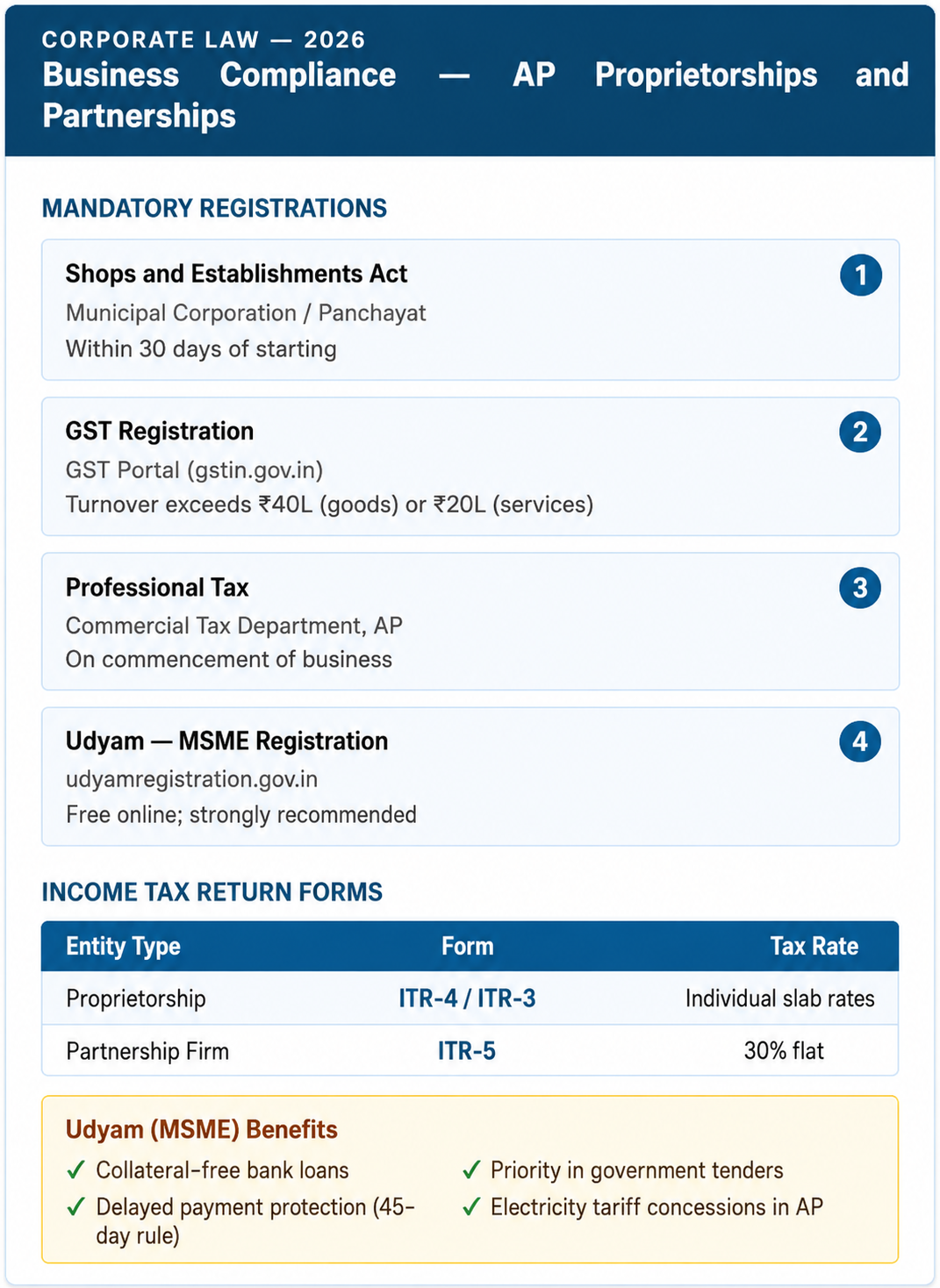
Business Compliance Checklist for Proprietorships and Partnership Firms in Andhra Pradesh — 2026
Most businesses in India are proprietorships or partnership firms. This guide covers all mandatory registrations, income tax compliance, GST obligations, professional tax, Udyam (MSME) registration and a practical annual compliance calendar for small businesses in 2026.
The Small Business Landscape in Andhra Pradesh
In Srikakulam and most small towns of Andhra Pradesh or all over India the overwhelming majority of businesses operate as:
Proprietorship firms — owned and run by a single individual who is personally liable for all business debts
Partnership firms — owned by two or more partners who share profits and bear unlimited personal liability
Both structures are simple to start, inexpensive to maintain and do not require company registration. However, they carry specific compliance obligations that are mandatory regardless of the size of the business.
1. Shops and Establishments Registration (Mandatory for All)
Every business in Andhra Pradesh that is not a factory must register under the AP Shops and Establishments Act, 1988 .
Particulars
Details
Who must register
Every shop, commercial establishment, office, hotel, eating house, restaurant and entertainment venue
Registration authority
Local Municipal Corporation or Town Panchayat
When to register
Within 30 days of commencing business
Renewal
Annual renewal required
Why it matters
Required to open a firm bank account, necessary for GST registration and trade license applications
Penalty for non-registration
Fine up to ₹5,000
2. GST Registration
Business Type
Threshold for Mandatory Registration
Goods — products, manufacturing, trading
Annual turnover exceeds ₹40,00,000
Services — consulting, professionals, contractors
Annual turnover exceeds ₹20,00,000
Inter-state supply of goods or services
Mandatory regardless of turnover
Selling on e-commerce platforms
Mandatory regardless of turnover
Andhra Pradesh is a normal state — registration is mandatory at ₹40 lakh for goods and ₹20 lakh for services. Voluntary registration is useful even below the threshold if your customers are GST-registered businesses who need Input Tax Credit from your invoices.
3. Professional Tax Registration (Andhra Pradesh)
Particulars
Details
Applicable to
Every employer and self-employed person in trade, profession or employment
Maximum annual rate
₹2,500 per year
Authority
Commercial Tax Department, Andhra Pradesh
Employer’s duty
Deduct from employee salaries and deposit with the government
Deductible
Professional tax paid is deductible from taxable income
Udyam Registration is the official MSME registration under the Ministry of MSME. It is free and fully paperless at udyamregistration.gov.in .
Benefits of Udyam Registration
Benefit
Details
Collateral-free loans
Loans under CGTMSE scheme without pledging assets
Lower interest rates
Banks and NBFCs offer preferential rates to MSMEs
Priority in government tenders
25% of all central government procurement is reserved for MSMEs
Delayed payment protection
Buyers must pay MSMEs within 45 days — non-payment attracts compound interest at 3× bank rate
Electricity tariff concession
AP state government offers electricity tariff rebates to registered MSMEs
Subsidy access
Access to state and central government subsidies and schemes
MSME Classification (Revised Limits)
Category
Investment in Plant and Machinery
Annual Turnover
Micro Enterprise
Up to ₹1 crore
Up to ₹5 crore
Small Enterprise
Up to ₹10 crore
Up to ₹50 crore
Medium Enterprise
Up to ₹50 crore
Up to ₹250 crore
5. Trade License
A Trade License from the local Municipal Corporation is required for specific categories: Food businesses (restaurants, hotels, dhabas, bakeries, sweet shops) Petrol pumps and fuel stations Chemical storage and hazardous materials handling Meat shops, fish markets and slaughterhouses
Income Tax Compliance
Proprietorship Firm
Particulars
Details
Legal status
Not a separate entity — business income is the owner’s personal income
Return form
ITR-4 (if opting for presumptive taxation) or ITR-3 (if maintaining full books)
Tax rate
Individual income tax slabs under the default or old regime
Presumptive taxation
Turnover up to ₹3 crore — declare minimum 8% as profit; professional services up to ₹75 lakh — declare minimum 50%
Advance tax
Required if tax liability exceeds ₹10,000
Return due date
31 July (non-audit cases) or 31 October (if tax audit required)
Partnership Firm
Particulars
Details
Legal status
Separate entity for tax purposes but not for liability
Return form
ITR-5
Tax rate
30% flat on the firm’s total income plus surcharge and 4% cess
Partners’ share
Each partner’s share of firm profit is exempt in their individual income tax returns
Advance tax
Firm must pay advance tax if liability exceeds ₹10,000
Tax audit
Mandatory if turnover exceeds ₹1 crore (₹3 crore if at least 95% of receipts are digital)
Return due date
31 July (non-audit) or 31 October (audit cases)
TDS Obligations for Small Businesses
Payment Type
TDS Rate
Threshold
Contractor or sub-contractor payments
2% (company) / 1% (individual or HUF)
Single payment above ₹30,000 or aggregate above ₹1,00,000
Professional fees (doctors, lawyers, CAs)
10%
Aggregate above ₹50,000 per year
Rent for land or building
10%
Aggregate above ₹2,40,000 per year
Salary to employees
As per applicable slab
On every payment
Commission or brokerage
5%
Aggregate above ₹15,000 per year
TDS obligations apply to all partnership firms and to proprietorship firms where the owner’s turnover exceeded ₹1 crore (goods) or ₹50 lakh (services) in the preceding Tax Year.
When to Consider Converting to an LLP?
Situation
Consider Converting
A partner dies and you want the business to continue automatically
LLP has perpetual succession
You want to limit each partner’s personal liability
LLP limits liability to each partner’s contribution
A key client or bank requires a more formal entity
LLP is more credible than a partnership deed
You want to add new partners with documented rights
LLP agreement provides a clear, registered structure
Turnover has grown substantially and you have employees
LLP compliance is manageable and liability protection improves
You want to raise equity capital from investors
Consider a Private Limited Company instead
Annual Compliance Calendar for Small Businesses
Month
What to Complete
April
Start of Tax Year; choose tax regime; file GSTR-1 for March
June
Pay 1st advance tax instalment (15% of estimated annual tax) by 15 June
July
File income tax return by 31 July (non-audit cases); renew Shops Act license if due
September
Pay 2nd advance tax instalment (45% cumulative) by 15 September
October
File income tax return (audit cases) by 31 October; GSTR-9C if applicable
December
Pay 3rd advance tax instalment (75% cumulative) by 15 December; file GSTR-9 by 31 December
January–March
Finalise books for Tax Year; issue Form 16A to vendors for TDS; professional tax renewal
March
Pay 4th advance tax instalment (100%) by 15 March
Monthly
GSTR-1 by 11th; GSTR-3B by 20th
The information provided herein is for general guidance and informational purposes only. For advice tailored to your specific situation, please consult a qualified Chartered Accountant.