The Income Tax Act, 2025 governs Tax Year 2026-27 (April 2026 onwards). The default tax regime offers nil tax on income up to ₹12 lakh for resident individuals after the rebate. If you have home loan interest, PPF and ELSS investments or health insurance premiums, the old regime may save you more. This guide explains both regimes, their rates and which deductions are available under each.
The Income Tax Act, 2025 — Two Tax Regimes for Individuals
From Tax Year 2026-27 (income earned 1 April 2026 to 31 March 2027), the Income Tax Act, 2025 governs individual taxation. Individuals and HUFs can choose between:
- Default New Regime — lower tax rates with Standard Deduction of ₹75,000 for salaried individuals and very limited additional deductions.
- Optional Old Regime — higher slab rates but full deductions (PPF, ELSS, LIC premium, health insurance, home loan interest etc.)
The default regime applies automatically unless you opt for the old regime. Salaried employees must inform their employer at the start of the Tax Year (April 2026). Others can switch at the time of filing the return.
Default New Regime — Tax Slabs for Tax Year 2026-27
| Income Slab | Tax Rate |
|---|---|
| Up to ₹4,00,000 | Nil |
| ₹4,00,001 – ₹8,00,000 | 5% |
| ₹8,00,001 – ₹12,00,000 | 10% |
| ₹12,00,001 – ₹16,00,000 | 15% |
| ₹16,00,001 – ₹20,00,000 | 20% |
| ₹20,00,001 – ₹24,00,000 | 25% |
| Above ₹24,00,000 | 30% |
Surcharge applies at 10% on income above ₹50 lakh and 15% above ₹1 crore. Health and Education Cess: 4% on tax plus surcharge.
Rebate — Zero Tax on Income up to ₹12 Lakh
Resident individuals with total income up to ₹12,00,000 under the default regime pay zero income tax after the rebate under the IT Act, 2025. The computed tax on ₹12 lakh is ₹80,000 — the rebate eliminates it entirely.
For salaried individuals, the Standard Deduction of ₹75,000 means that gross salary up to ₹12,75,000 results in zero tax (Standard Deduction reduces taxable income to ₹12 lakh and the rebate applies).
| Gross Salary | Standard Deduction | Taxable Income | Tax Payable |
|---|---|---|---|
| ₹8,00,000 | ₹75,000 | ₹7,25,000 | Nil (rebate) |
| ₹12,75,000 | ₹75,000 | ₹12,00,000 | Nil (rebate) |
| ₹15,00,000 | ₹75,000 | ₹14,25,000 | ₹1,68,750 + cess |
| ₹20,00,000 | ₹75,000 | ₹19,25,000 | ₹3,38,750 + cess |
The rebate applies only to resident individuals. HUFs and Non-Resident Indians are not eligible.
What Deductions Are Allowed in the Default Regime?
| Deduction | Available in Default Regime? |
|---|---|
| Standard Deduction — ₹75,000 (salaried and pensioners) | Yes |
| Standard Deduction for family pension — ₹25,000 | Yes |
| Employer’s NPS contribution — up to 14% of salary (government) or 10% (private) | Yes |
| Gratuity exemption on retirement | Yes |
| Leave Encashment exemption on retirement | Yes |
| Interest on home loan (Section 24b equivalent) | No |
| Investment deductions — PPF, ELSS, LIC, EPF etc. | No |
| Health insurance premium | No |
| Additional NPS contribution above employer’s contribution | No |
| HRA exemption | No |
| Leave Travel Allowance | No |
Optional Old Regime — Tax Slabs
| Income Slab | Tax Rate |
|---|---|
| Up to ₹2,50,000 | Nil |
| ₹2,50,001 – ₹5,00,000 | 5% |
| ₹5,00,001 – ₹10,00,000 | 20% |
| Above ₹10,00,000 | 30% |
Rebate for old regime: income up to ₹5 lakh → nil tax after rebate. Standard Deduction for salaried: ₹50,000.
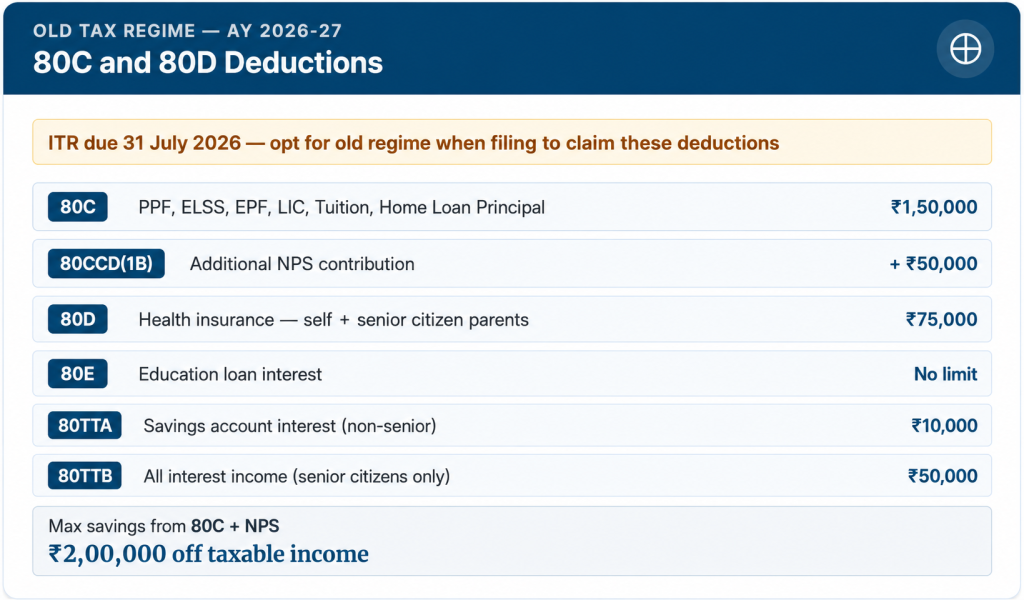
Investment Deductions Under the Old Regime —
₹1,50,000 per Year
| Investment | Key Feature |
|---|---|
| PPF (Public Provident Fund) | 15-year lock-in; interest tax-free |
| EPF / VPF (own contribution) | Employer’s share excluded from this limit |
| ELSS Mutual Funds | 3-year lock-in; market-linked returns |
| NSC (National Savings Certificate) | 5-year lock-in; accrued interest also qualifies |
| Sukanya Samriddhi Yojana | For girl child below 10 years |
| Senior Citizen Savings Scheme | For age 60+; quarterly interest payout |
| 5-Year Tax-Saving Bank FD | 5-year lock-in at any scheduled bank |
| Life Insurance Premium | For self, spouse or children |
| Tuition Fees | Up to 2 children (tuition only; not hostel, coaching or transport) |
| Home Loan Principal | Qualifies in the year of repayment |
Maximum: ₹1,50,000 per year
Additional NPS Deduction — ₹50,000 above the ₹1,50,000 Limit
Your own NPS contribution up to ₹50,000 qualifies for an additional deduction over and above the ₹1,50,000 investment limit. Combined total possible: ₹2,00,000. Employer’s NPS contribution (up to 10% of salary) is separately deductible and also available in the default regime.
Health Insurance Deduction — Old Regime
| Premium Paid For | Self Below 60 | Self Aged 60+ |
|---|---|---|
| Self, spouse and children | ₹25,000 | ₹50,000 |
| Parents below 60 | + ₹25,000 | + ₹25,000 |
| Parents aged 60 or above | + ₹50,000 | + ₹50,000 |
| Maximum (self + senior citizen parents) | ₹75,000 | ₹1,00,000 |
Cash payments are not eligible except ₹5,000 for preventive health check-ups. All other premium payments must be made by cheque, net banking, UPI or any non-cash mode.
Home Loan Interest — Up to ₹2,00,000 (Old Regime Only)
Interest on a home loan for a self-occupied residential property is deductible up to ₹2,00,000 per year under the old regime. For a rented property, the full interest is deductible subject to overall house property loss limits.
Other Deductions Under the Old Regime
| Deduction | What It Covers | Limit |
|---|---|---|
| Education loan interest | Higher education in India or abroad; self, spouse or children | No monetary limit; available for 8 years |
| Savings account interest | Interest from savings accounts at banks, co-operative banks or post offices | ₹10,000 (₹50,000 for senior citizens — covers FD interest too) |
| Eligible donations | Charities with approved income tax exemption certificate | 50% or 100% of donation; cash above ₹2,000 not eligible |
Which Regime Saves More? — A Practical Guide
| Your Situation | Likely Better Regime |
|---|---|
| Gross salary up to ₹12,75,000, no major deductions | Default regime — nil tax after rebate |
| Salary ₹12-20 lakh with home loan interest, 80C and 80D | Compute under both regimes and compare |
| Salary above ₹20 lakh with home loan + investments + health insurance | Old regime frequently saves more |
| No home loan, no PPF/ELSS, no HRA | Default regime almost always better |
| Self-employed professional with significant deductions | Compute both; old regime suits high-deduction cases |
The only reliable method is to compute your tax under both regimes
and compare the actual numbers. A Chartered Accountant can help with
this calculation for Tax Year 2026-27.
Choosing Your Regime — Deadlines
| Taxpayer Type | When to Declare | If Not Declared |
|---|---|---|
| Salaried (employer TDS deduction) | Inform employer at the start of April 2026 | Default regime applied for TDS |
| Salaried (switching at return filing) | At the time of filing the Tax Year 2026-27 return in 2027 | Can switch once at filing if within due date |
| Self-employed with business income | At the time of filing the return | Default regime applied automatically |
The information provided herein is for general guidance and informational purposes only. For
advice tailored to your specific situation, please consult a qualified Chartered Accountant.